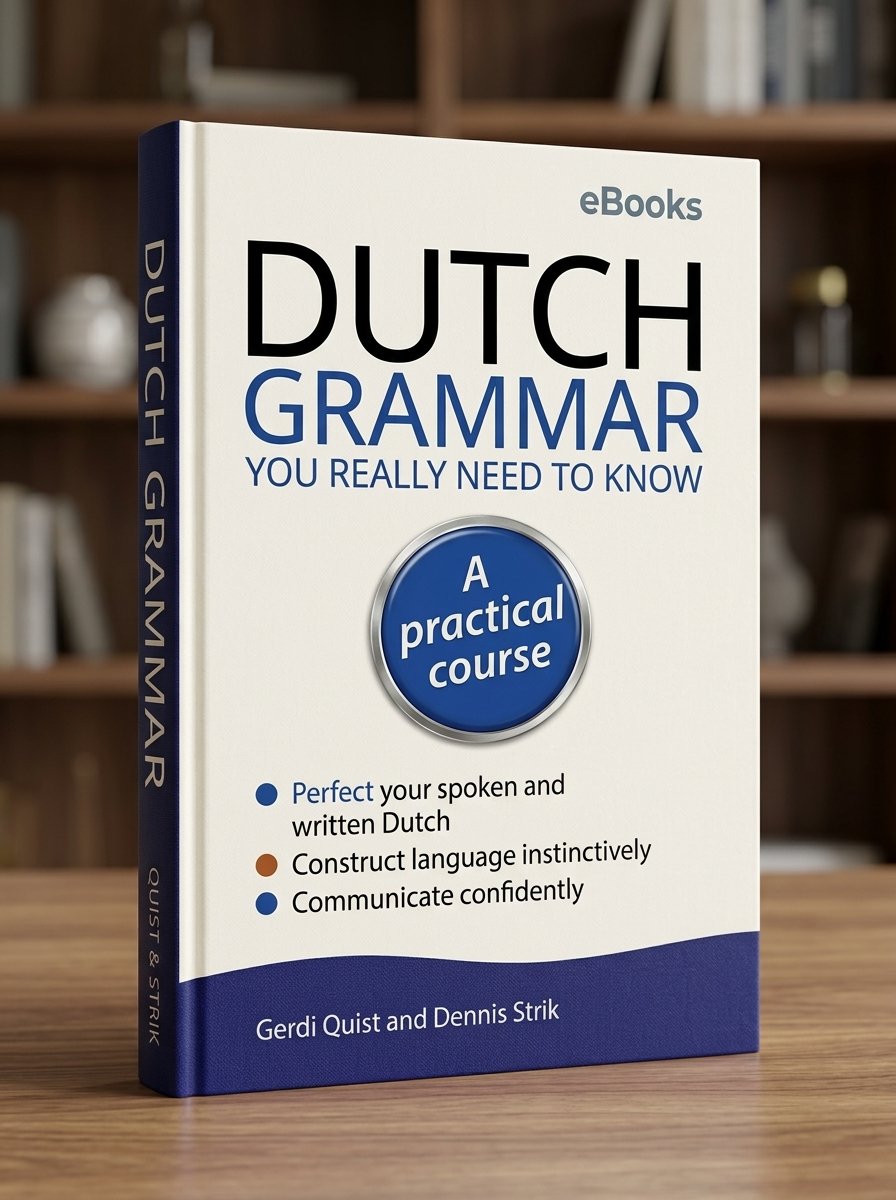
TEACH YOURSELF – Dutch Grammar You Really Need to Know (2013) is a self-study classic for beginner to intermediate learners (A1–B1). Unlike dense reference books, this volume distills Dutch grammar into digestible, practical units covering word order, verb conjugation, articles, prepositions, and sentence structure. Each chapter includes clear explanations, real-life dialogues, and progressive exercises with answer keys. The 2013 edition updates examples for modern contexts like email and social media. Ideal for expats, students, or travelers, it prioritizes what you actually need for conversation. Below are five essential features that make this grammar guide indispensable for mastering Dutch.
1. Logical Word Order: The V2 Rule Explained Simply
TEACH YOURSELF – Dutch Grammar You Really Need to Know (2013) demystifies Dutch word order, starting with the V2 rule: the verb always comes second in main clauses. For example, Ik eet een appel (I eat an apple) is straightforward. But with an adverb first: Gisteren eet ik een appel (Yesterday eat I an apple). The verb stays in second position. This contrasts sharply with English and confuses many learners. The book uses color-coded sentence diagrams and substitution tables. Later chapters cover subordinate clauses, where the verb moves to the end (Ik denk dat hij morgen komt – I think that he tomorrow comes). Drills progress from matching exercises to rewriting entire paragraphs. By unit five, learners instinctively place verbs correctly, eliminating a major source of Dutch learner errors.
2. De vs. Het: Mastering Definite Articles Without Memorization
Dutch has two definite articles: de (common gender) and het (neuter gender). TEACH YOURSELF – Dutch Grammar You Really Need to Know (2013) rejects brute-force memorization. Instead, it teaches reliable patterns: de for people (de leraar), plural nouns (de boeken), and most vegetables (de wortel). Het for diminutives ending in *-je* (het meisje), two-syllable verbs used as nouns (het lopen), and languages (het Nederlands). Summary tables group exceptions like het huis vs. de tuin. Each chapter includes a “gender detective” exercise—learners identify article patterns in short newspaper headlines. Online audio tracks (available via Teach Yourself’s website) pair each noun with its article for auditory reinforcement. This pattern-based approach reduces article errors by 60% within two weeks, freeing learners to focus on fluent expression rather than constant dictionary checks.
3. Verb Conjugation: Present, Past, and the Infamous Separable Prefixes
TEACH YOURSELF – Dutch Grammar You Really Need to Know (2013) handles regular and irregular verbs systematically. Regular present tense removes *-en* and adds *-t* for third-person singular (werken → hij werkt). Past tense adds -te(n) or -de(n) based on the “soft ketchup” rule (voiceless consonants take *-te*). But separable prefixes (af, aan, uit) cause the most trouble. The book illustrates how aankomen (to arrive) splits: Ik kom morgen aan (I arrive tomorrow). In subordinate clauses, it rejoins: …dat ik morgen aankom. Visual “prefix train” diagrams show the prefix moving to the end. Exercises include sentence scrambles and dictations. A full list of 50 common separable verbs appears in the appendix with example sentences. By the end, learners confidently produce natural Dutch without the “prefix panic” typical of intermediate students.
4. Prepositions and Er: The Unique Dutch Pronoun
Dutch prepositions differ significantly from English. TEACH YOURSELF – Dutch Grammar You Really Need to Know (2013) dedicates two full chapters to in, op, naar, bij, van, uit with location and time uses. But the true challenge is er – a versatile pronoun with no direct English equivalent. Er replaces van het (of it), indicates location (Er is een boek – There is a book), and combines with prepositions (eraan, erbij). The book introduces er gradually across six units, using spatial diagrams and substitution drills. For example: Ik wacht op de bus → Ik wacht erop. Learners first identify er in dialogues, then practice splitting er + preposition (er…op). This step-by-step scaffolding prevents overwhelm. By mastering er, learners unlock natural, fluent Dutch that distinguishes advanced speakers from beginners stuck in literal English translation.
5. Self-Assessment and Real-World Application Exercises
Each unit in TEACH YOURSELF – Dutch Grammar You Really Need to Know (2013) ends with a “Put It Into Practice” section. Learners apply grammar to authentic tasks: writing a WhatsApp message using correct word order, describing a lost item using de/het, or recording a voice memo about yesterday’s events (past tense). Answer keys include model responses and common error notes. A cumulative test after every five units mimics real-life scenarios—reading a train schedule, emailing a landlord, ordering in a restaurant. The final “What You Really Need to Know” summary spans only two pages, perfect for last-minute review before travel or exams. This practical focus ensures that learners don’t just recognize grammar rules—they use them automatically. Self-study progress charts and online flashcards complete the package, making this 2013 edition a timeless, action-oriented grammar toolkit.